


Menopause and Hair Loss in Women: Exploring the Hormonal Transition

You've navigated the hot flushes, managed the mood shifts, and made peace with the sleepless nights. But there is one aspect of menopause that many women find unexpectedly distressing — and it often goes undiscussed in the doctor's office: hair loss.
For countless women, menopause brings not just a change in their reproductive cycle but a visible, tangible change in their hair. The ponytail feels thinner. The part looks wider. More hair collects in the shower drain and on the hairbrush. And unlike other menopausal symptoms that tend to ease with time, hair loss can feel relentlessly progressive — quietly eroding confidence and self-image in a way that is difficult to articulate to others.
At Dunedin Medical & Aesthetics Clinic, we believe that menopause and hair loss in women deserves to be taken seriously — not dismissed as vanity, but recognised as a legitimate medical concern with real, evidence-based solutions. In this guide, we explore exactly why women lose hair during menopause, what is happening hormonally, and what options are available to help.
Understanding Menopause and Hair Loss in Women: The Hormonal Science
To understand why menopause causes hair loss, we first need to understand how hormones govern hair growth throughout a woman's life.
Hair growth occurs in a cyclical pattern, moving through three key phases:
Anagen — the active growth phase, lasting 2 to 7 years
Catagen — the transitional phase, lasting 2 to 3 weeks
Telogen — the resting and shedding phase, lasting approximately 3 months
The hormones oestrogen and progesterone play a critical role in prolonging the anagen (growth) phase. Higher levels of these hormones — as experienced during the reproductive years and particularly during pregnancy — keep more hair follicles in active growth at any given time. This is why many women enjoy thick, lustrous hair during pregnancy.
As women approach perimenopause and menopause, oestrogen and progesterone levels decline significantly. With less hormonal support for the growth phase, hair follicles spend more time in the telogen (resting and shedding) phase. The result is increased shedding, reduced hair density, and a gradual thinning that can affect the entire scalp — though it is often most visible at the crown and along the parting.
The Role of Androgens in Menopausal Hair Loss
Oestrogen decline is only part of the picture. As oestrogen falls, the relative influence of androgens — male hormones including testosterone and its more potent derivative dihydrotestosterone (DHT) — increases. This hormonal shift is central to understanding menopause and hair loss in women.
DHT binds to androgen receptors in genetically susceptible hair follicles and causes a process known as follicular miniaturisation — the gradual shrinking of the hair follicle over successive growth cycles. Each new hair that grows becomes progressively finer, shorter, and lighter, until eventually the follicle may cease producing a visible hair altogether.
This pattern of hair loss — diffuse thinning predominantly at the crown and top of the scalp, with relative preservation of the frontal hairline — is known as Female Pattern Hair Loss (FPHL) or androgenetic alopecia in women. Menopause significantly accelerates this process in women who are genetically predisposed.
It is worth noting that not all menopausal hair loss follows the androgenetic pattern. Some women experience more diffuse, generalised shedding — a condition known as telogen effluvium — in which a significant physiological stress (such as the hormonal upheaval of menopause itself) triggers a mass shift of hair follicles into the resting phase simultaneously, resulting in noticeably increased shedding over weeks to months.
Why Do Women Lose Hair During Menopause? Key Factors
1. Declining Oestrogen and Progesterone
As outlined above, reduced levels of these hair-protective hormones shorten the growth phase and increase the proportion of follicles in the shedding phase at any given time.
2. Relative Androgen Dominance
With oestrogen no longer counterbalancing androgens, DHT activity at the follicle level increases — accelerating miniaturisation in susceptible follicles.
3. Increased Physiological Stress
The hormonal turbulence of perimenopause itself can trigger telogen effluvium — a stress-related, diffuse hair shedding that may occur simultaneously with or independently of androgenetic hair loss.
4. Nutritional Deficiencies
Menopause is associated with changes in nutrient absorption and metabolism. Deficiencies in iron, ferritin, vitamin D, zinc, and B vitamins — all of which are essential to healthy hair growth — are common in perimenopausal and postmenopausal women and can significantly compound hormonally driven hair loss.
5. Thyroid Dysfunction
Thyroid disorders, particularly hypothyroidism, become more prevalent in women during and after menopause. Thyroid dysfunction is a significant independent cause of hair thinning and shedding — and is often overlooked when symptoms are attributed solely to menopause.
6. Scalp Changes
Declining oestrogen also affects sebum production and scalp health. A drier, less well-nourished scalp creates a less optimal environment for hair follicle function and can exacerbate existing hair thinning.
7. Psychological Stress
The cumulative stress of navigating menopause — disrupted sleep, mood changes, physical symptoms, and identity shifts — is itself a recognised trigger for telogen effluvium, creating a compounding cycle that is difficult to untangle.
How Is Menopausal Hair Loss Diagnosed?
At Dunedin Medical & Aesthetics Clinic, we take a thorough, investigative approach to menopause and hair loss in women. A proper assessment may include:
A detailed medical and hormonal history
Examination of the hair and scalp — including the pattern, distribution, and quality of hair loss
Blood tests to assess hormone levels (oestrogen, testosterone, DHEAS), thyroid function, iron stores (ferritin), vitamin D, zinc, and full blood count
Assessment of nutritional status and current medications
Trichoscopy or dermoscopy of the scalp where indicated
This comprehensive approach ensures that all contributing factors are identified — because treating hair loss effectively means treating the whole picture, not just the most obvious symptom.
What Treatment Options Are Available?
The good news is that menopausal hair loss is neither inevitable nor irreversible in many cases — particularly when identified and addressed early. Treatment options vary depending on the underlying cause, severity, and individual health profile.
Hormone Replacement Therapy (HRT)
For women where declining oestrogen is the primary driver, HRT may help stabilise or partially reverse hormonally driven hair loss, in addition to addressing other menopausal symptoms. This is a complex area that requires careful medical assessment and individualised prescribing — your doctor will discuss whether HRT is appropriate for your circumstances.
Topical Minoxidil
Minoxidil is the most widely evidence-supported topical treatment for female pattern hair loss. Applied directly to the scalp, it prolongs the anagen growth phase and increases blood flow to follicles. It is available in various strengths and formulations and is suitable for many women with androgenetic hair loss.
Nutritional Supplementation
Correcting deficiencies in iron, ferritin, vitamin D, zinc, and B vitamins can make a meaningful difference to hair loss driven or compounded by nutritional insufficiency. Supplementation should be guided by blood test results rather than taken indiscriminately.
PRP (Platelet-Rich Plasma) Therapy
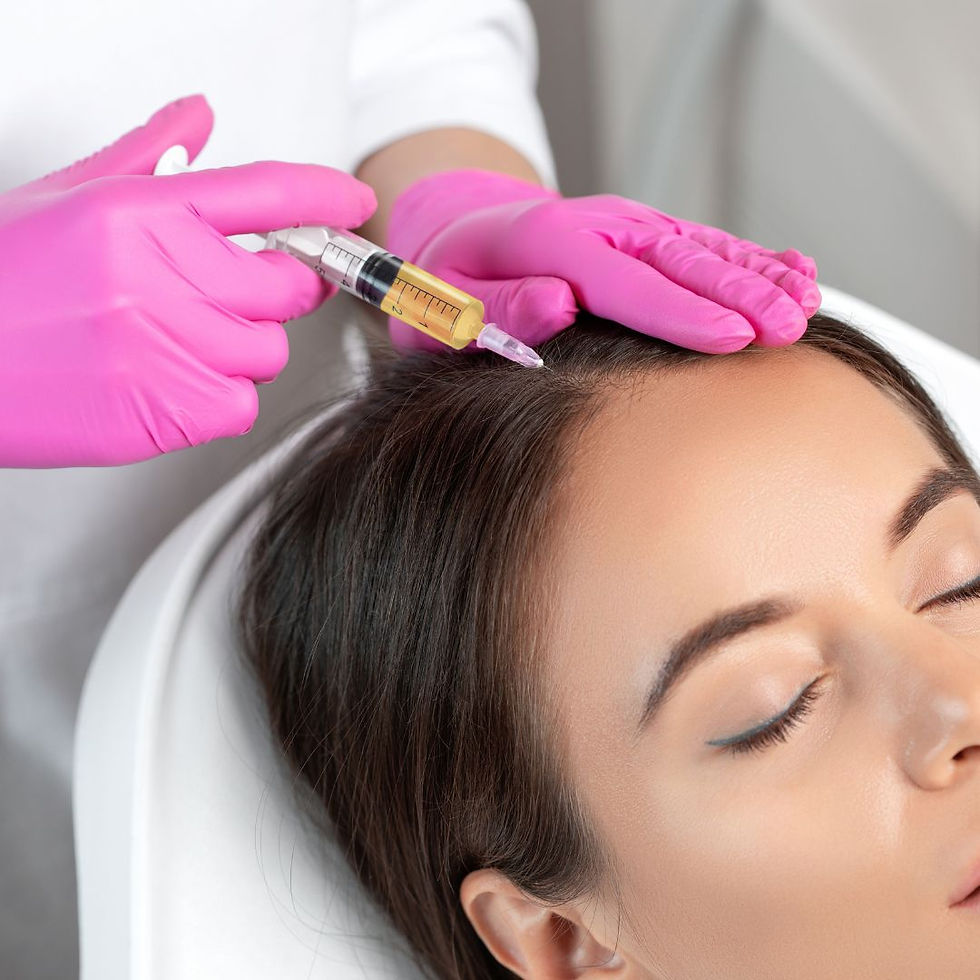
PRP hair treatment involves drawing a small amount of the patient's own blood, concentrating the growth-factor-rich plasma, and injecting it directly into the scalp. Growth factors in PRP stimulate follicular activity, prolong the growth phase, and improve the health of the scalp environment. It is an increasingly popular and well-tolerated option for menopausal hair loss.
PDRN (Polynucleotide) Scalp Treatment
PDRN — derived from salmon DNA — is an emerging regenerative treatment that promotes cellular repair and tissue regeneration. When applied to the scalp, it can improve follicular health and scalp quality, making it a valuable complementary treatment for hair loss associated with scalp ageing and hormonal change.
Lifestyle and Stress Management
Addressing sleep quality, psychological stress, and nutritional habits forms an essential foundation for any hair loss treatment programme. No medical intervention will achieve optimal results without supporting overall health and wellbeing.
When Should You Seek Help?
We encourage women to seek assessment sooner rather than later. Hair follicles that have undergone significant miniaturisation are much harder to revive than those in the earlier stages of decline. If you have noticed:
Increased hair shedding on your pillow, in the shower, or on your brush
A wider parting or more visible scalp at the crown
A noticeably thinner ponytail or reduced overall hair volume
Hair that feels finer, more fragile, or grows more slowly than before
...then it is worth having a proper assessment — regardless of whether you are in perimenopause, recently postmenopausal, or years past your last period.
You Are Not Alone — and You Don't Have to Accept It
Menopause and hair loss in women is a topic that has long been under-researched and under-discussed relative to its genuine prevalence and impact. Studies suggest that up to 50% of women will experience noticeable hair thinning by the age of 50 — yet many suffer in silence, unsure whether help is available or feeling that their concern will be dismissed.
At Dunedin Medical & Aesthetics Clinic, we are here to listen, investigate thoroughly, and offer a personalised, evidence-based approach to menopausal hair loss. You deserve to feel like yourself — and that includes your hair.
Book a Consultation at Dunedin Medical & Aesthetics Clinic
If menopause and hair loss are affecting your confidence and quality of life, we invite you to take the first step and book a consultation with our team. We will take the time to understand your individual situation and explore the most appropriate treatment options for you.
📍 Dunedin Medical & Aesthetics Clinic — Serving Dunedin and the Otago region
📞 021 790 789
This blog is intended for informational purposes only and does not constitute medical advice. Individual results vary. Please consult a qualified medical professional to determine the most appropriate assessment and treatment for your individual health circumstances.


Comments